



Fleas are small insects that feed mainly on the blood of dogs and cats. Biological characteristics, behaviour, risks to humans, treatments: here is everything you need to know about fleas.
Objective: to understand them better in order to eliminate them more effectively.
Key information
➡️Fleas are ectoparasitic insects: they feed on the blood of their hosts.
➡️Their hosts are mainly dogs and cats.
➡️They can bite humans, although animals are their preferred hosts.
➡️Flea bites are generally not serious for humans, but they cause severe itching.
➡️ Fleas are present all year round, with seasonal peaks.
➡️A female flea can lay between 20 and 50 eggs per day.
➡️To get rid of them, both the animal and the home must be treated.
What is a flea: description and characteristics of the insect
The flea is a small parasitic insect belonging to the order Siphonaptera (from the Latin sipho, meaning “tube”). It is one of the so-called biting-sucking insects, as it feeds exclusively on blood, which it draws from its hosts (mainly dogs and cats, but sometimes also humans). They are therefore classified as blood-sucking insects, in the same way as mosquitoes.
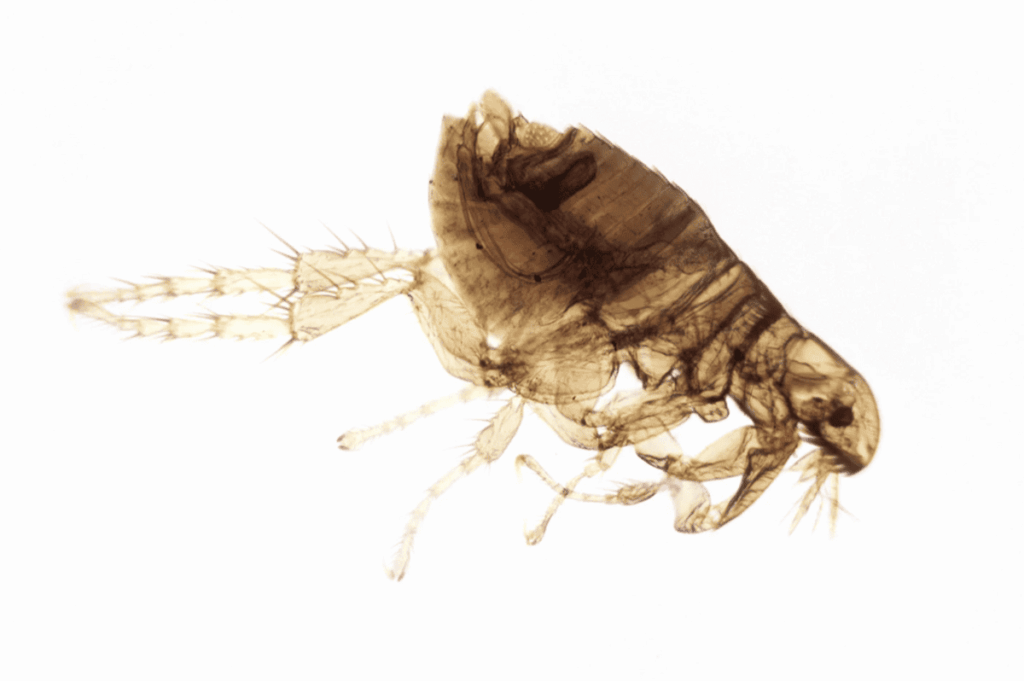
What does a flea look like?
Fleas are small, wingless insects protected by a layer covered with spines (cuticle).
- Size: approximately 3 to 8 mm.
- Colour: reddish-brown to blackish.
- Body: flattened laterally (on the sides), allowing it to easily slip between hairs or textile fibres.
- Legs: highly developed at the rear, capable of propelling the flea several dozen centimetres to move from one host to another.
Their anatomy is designed to:
- bite the skin,
- suck blood,
- move quickly from one host to another by jumping.
Difference from other biting insects
Fleas are often confused with other biting insects, but their behaviour is quite distinct:
| Mosquito | flies, bites mainly at night, does not remain on the host permanently. |
| Bed bugs | does not jump, hides in furniture and only bites to feed at night. |
| Tick | clings to the skin for a long time and remains attached for several days to feed. |
The flea jumps, bites quickly, then returns to its environment (pet basket, carpet, skirting boards, bedding).
For your information, there are three types of fleas:
- Fur fleas, which live exclusively on their host
- Nidicolic fleas, which live in their host’s shelter: pet basket, nest, burrow, etc.
- Sedentary fleas, which remain attached to their host in the same place without moving
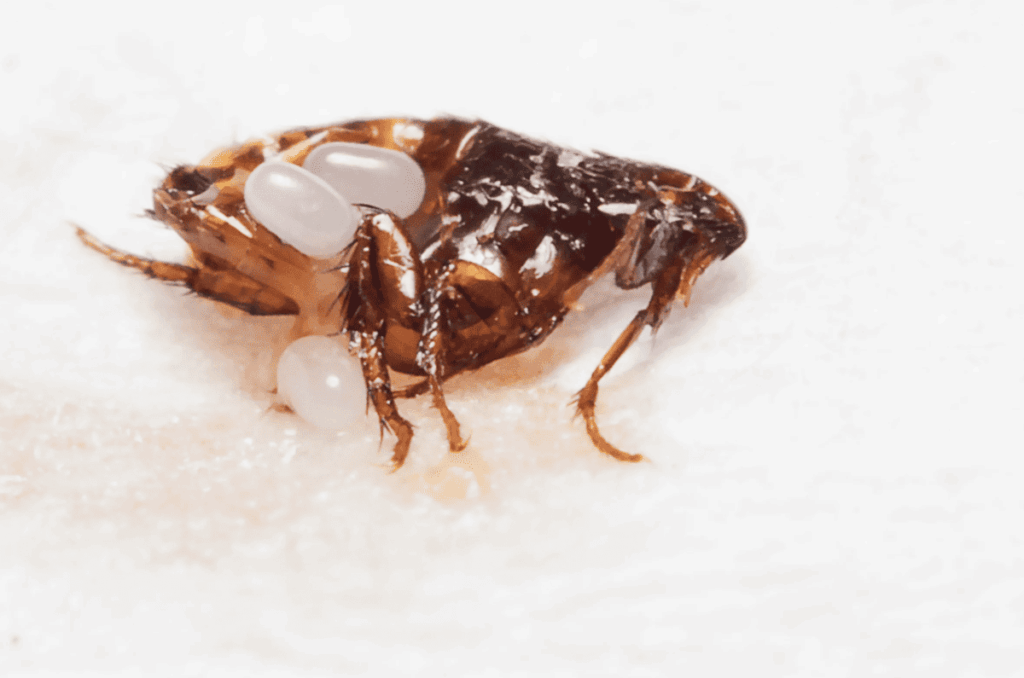
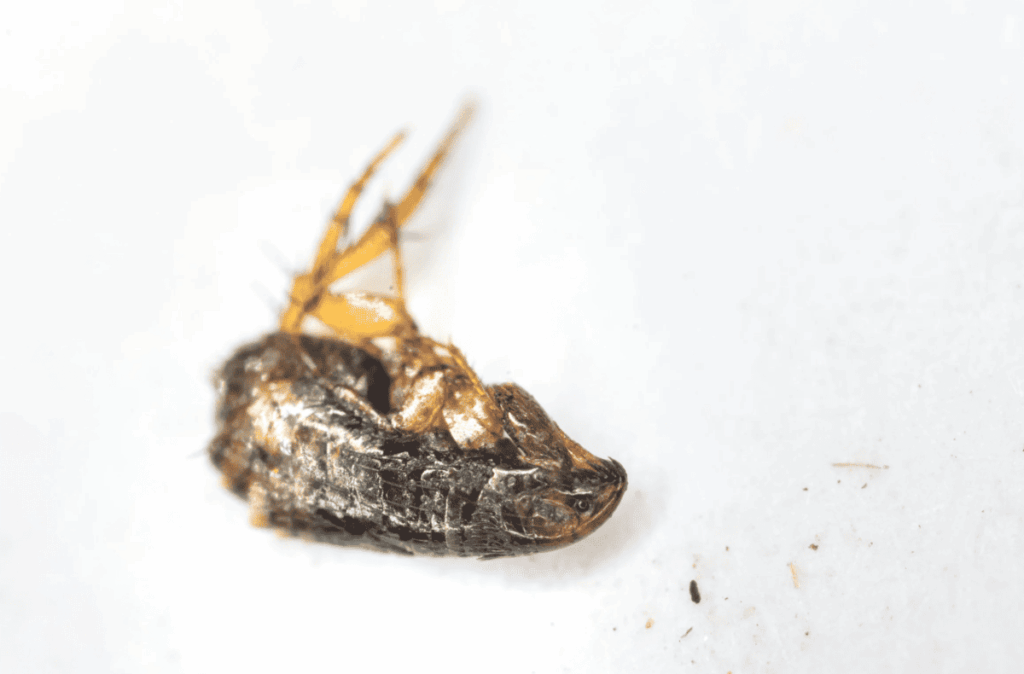
Photos of fleas
Life cycle of fleas: eggs, larvae, pupae and adults
1) Flea eggs
After each blood meal, the female flea begins to lay eggs rapidly. She can produce up to 50 eggs per day for 50 to 100 days. An infestation can therefore quickly take hold in a home.
Eggs hatch more easily when:
- the temperature is mild to warm (20–30 °C),
- the air is humid,
- access to food is easy, for example with the presence of domestic animals in the home.
These eggs resemble tiny white grains of rice measuring 0.5 mm.
Where are the eggs laid?
The eggs do not remain attached to the animal. They are mainly found in the environment:
- in the coat of dogs or cats (at the time of laying),
- then quickly in the soil,
- animal baskets and cushions,
- rugs and carpets,
- dust, cracks in parquet flooring and skirting boards.
Good to know: an interior can be infested even if few adult fleas are visible on the animal. The animal’s movements (walking, scratching, sleeping) are enough to scatter eggs throughout the house.
Flea larvae
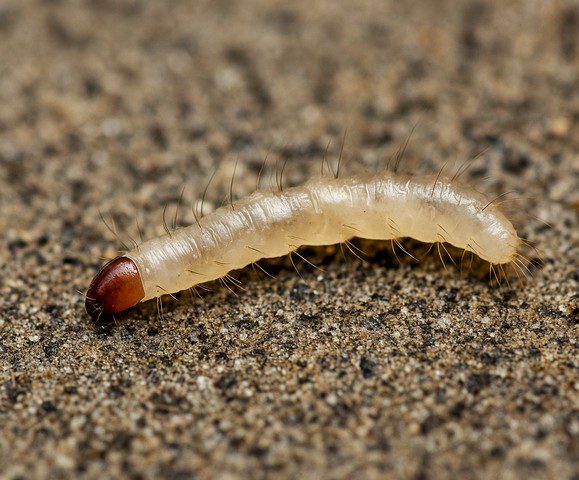
After the eggs hatch (between 2 and 10 days), fleas go through a larval stage that lasts between 5 and 11 days. These larvae develop entirely in the environment (not on the animal).
What do flea larvae look like?
- Small in size (approximately 1.5 mm),
- whitish to translucent in colour,
- shaped like a tiny worm,
- without legs or wings.
What do they feed on?
Unlike adult fleas, larvae do not bite or suck blood directly. They feed mainly on organic debris (dead skin, dust), dried blood contained in the excrement of adult fleas, or residues found in textiles (carpets, pet baskets, cushions).
This link between adult fleas and larvae explains why an infestation is self-sustaining: the adults indirectly feed the larvae.
Where do the larvae hide?
Flea larvae take refuge in places that are:
- dark,
- quiet,
- protected from traffic.
They are mainly found in:
- cracks in the floor,
- skirting boards,
- carpets and rugs,
- pet baskets and blankets,
- gaps in wooden floors and dusty areas.

Nymphs
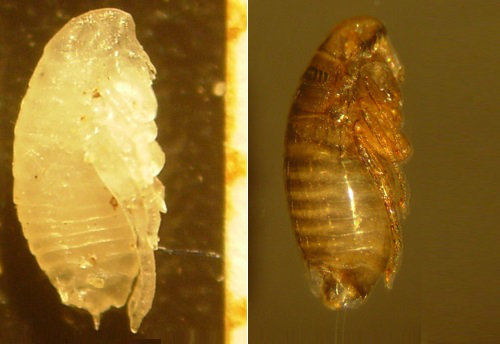
After the larval stage, the flea larva transforms into a nymph by enclosing itself in a protective cocoon made from dust, hair and other debris. This stage lasts a few weeks. During this period, the larva gradually takes on the shape of the adult insect with legs and antennae.
The cocoon protects the future adult flea from:
- moderate cold,
- dryness,
- and even certain insecticides.
The flea can remain in this cocoon for several weeks or even months, waiting for a host.
The adult flea
It is at this stage that the flea becomes a biting-sucking parasite, capable of causing infestation in both animals and humans.
A vital need for blood
In order to survive and reproduce, adult fleas must feed on blood. They bite their host (dogs, cats, but sometimes also humans) using their specialised mouthparts, then suck blood for several minutes.
Without a blood meal, they cannot lay eggs and eventually die.
Although their preferred targets are domestic animals, fleas can also bite humans when:
- the host animal is no longer available,
- the infestation is severe,
- or fleas are already present in the environment (carpets, bedding, sofas).
Life span of an adult flea
When conditions are favourable (heat, humidity, presence of a host), adult fleas can live for up to 3 to 4 months. Fleas can also live for several months without feeding by slowing down their metabolism.
The different species of fleas
Here are the most common species of fleas and their hosts.

The cat flea (Ctenocephalides felis)
The cat flea, or Ctenocephalides felis, accounts for the majority of infestations observed in private homes. It is found in both urban and rural areas, all year round when homes are heated.
Please note that this flea is not specific to cats. It also parasitises dogs and can bite humans if there are no animals present or in the event of a major infestation in the home.
Its bites are often clustered together, very pruritic (they itch intensely) and appear mainly on the legs and ankles in humans..
A particularly resistant flea
The cat flea is known for:
- their high reproductive capacity (a female flea lays around 25 eggs per day and 1,000 to 2,000 during her lifetime),
- their environmental resistance (eggs, larvae and cocoons survive for a long time in the home),
- and their ability to quickly colonise carpets, pet baskets, sofas and cracks in the floor.
Good to know: even if your pet does not go outside much, cat fleas can enter your home via another animal, clothing or an already infested environment.
The dog flea (Ctenocephalides canis)
The dog flea is a species closely related to the cat flea, with which it is often confused. However, Ctenocephalides canis is less widespread. In most cases of infestation in dogs, it is actually Ctenocephalides felis, which is more resistant and better adapted to indoor environments.
In terms of morphology and behaviour, the dog flea is almost identical to the cat flea.
Fleas can transmit worms (Dipylidium caninum) to dogs and trigger allergies.

Other possible hosts
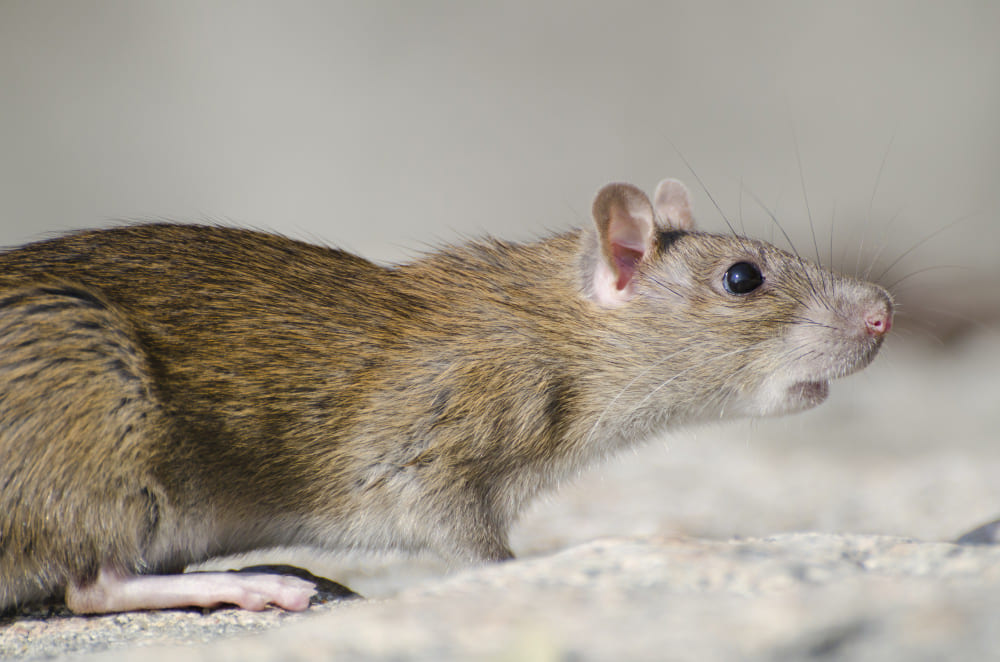
More rarely, there are fleas specific to certain wild animals, particularly rodents and small mammals:
- squirrels,
- martens,
- certain marsupials (in other parts of the world),
- rats and mice.
Risks and diseases associated with fleas
Most flea bites are harmless, but in some cases these insects can transmit diseases.
A historical reminder: the plague and the ‘plague flea’
Fleas are infamous for their role in the great plague epidemics of the Middle Ages.
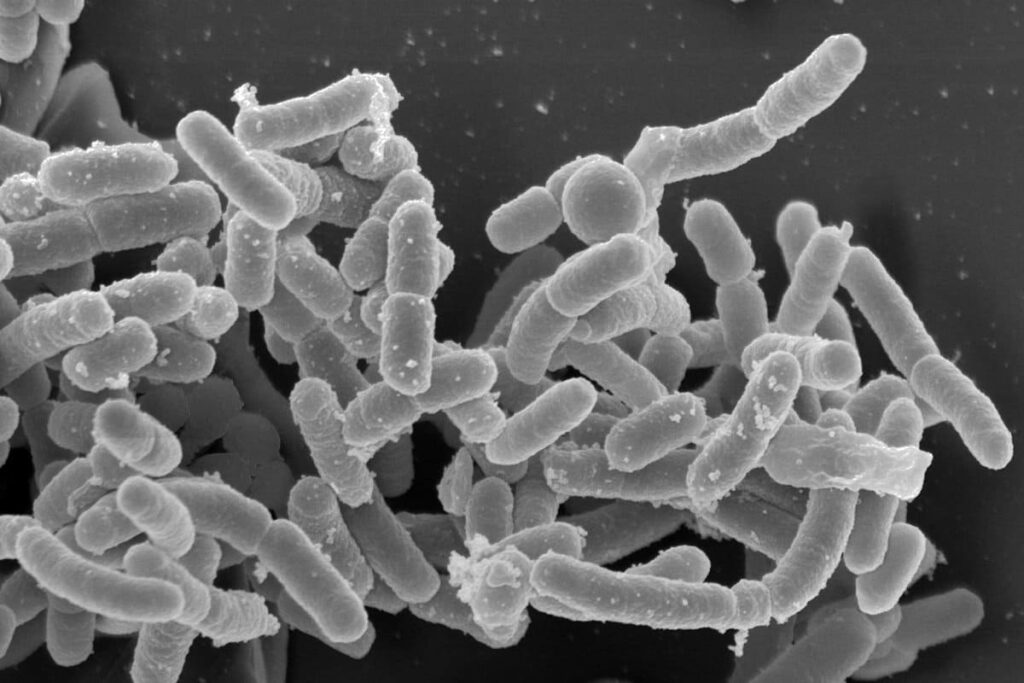
The bacterium Yersinia pestis was transmitted to humans by fleas living on rodents under infestation (particularly rats).
These were known as plague fleas, capable of infecting humans after biting an animal carrying the bacterium. Today, such cases are exceptional in Europe, but this historical episode explains why fleas are classified as potential disease vectors.
Risks to animals
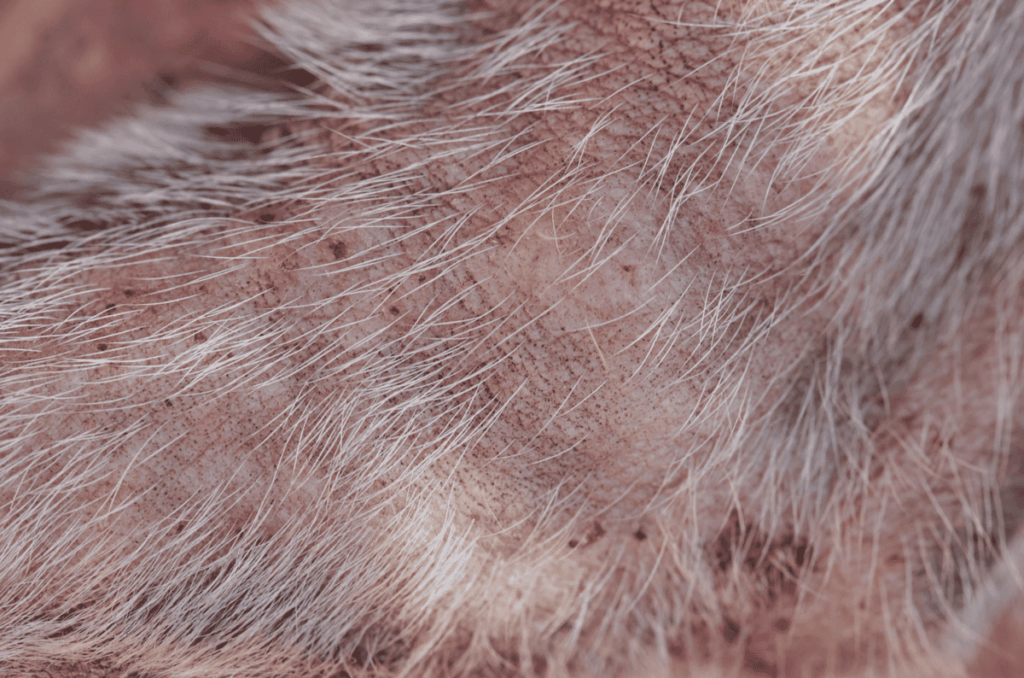
In dogs and cats, flea infestation can cause:
- intense itching,
- skin lesions caused by scratching (pruritus),
- allergic dermatitis caused by flea saliva,
- possible transmission of intestinal parasites (tapeworms),
- anaemia in young animals in the event of a massive infestation.
Animals are therefore the primary victims of fleas, well ahead of humans.
Risks to humans
In humans, fleas can cause:
- multiple bites, often on the legs, ankles or arms,
- severe itching,
- sometimes local allergic reactions,
- in very rare cases, secondary infection if the skin is scratched too much.
The transmission of serious diseases to humans remains very rare, but is theoretically possible in the presence of rodents with infestations or in highly degraded environments.
Certain species of fleas can carry bacteria that cause:
- prolonged fevers,
- headaches,
- intense fatigue,
- skin rashes.
Flea bites
Fleas are biting-sucking insects: they pierce the skin to feed on blood.
What does a flea bite look like?
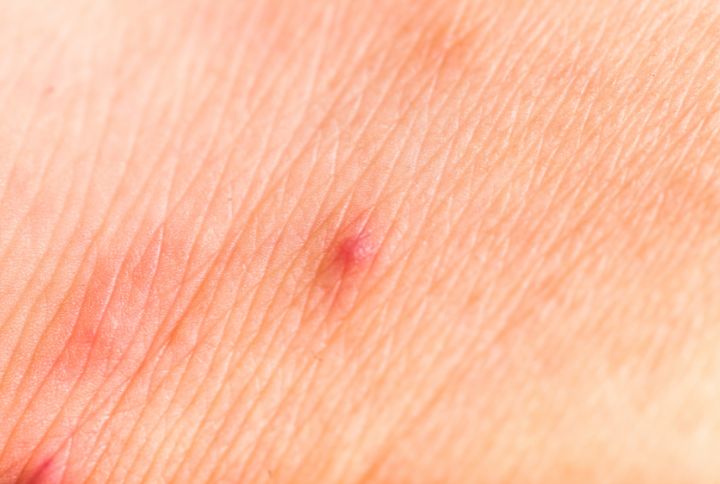
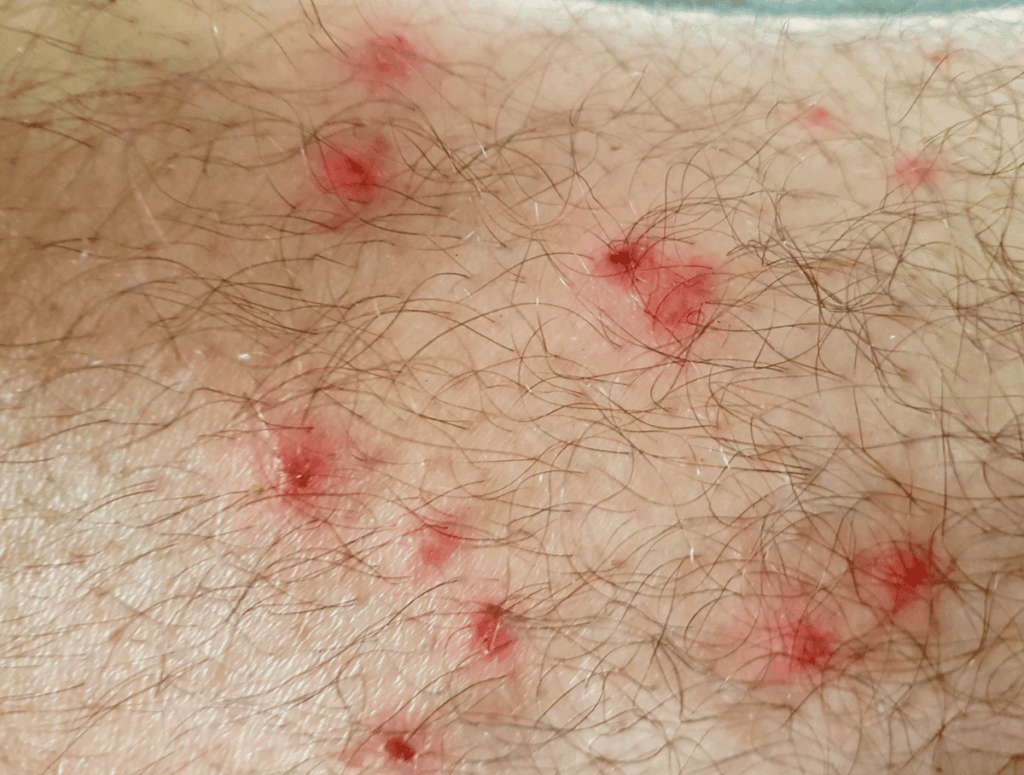
The bites are often clustered together, extremely itchy and located on the legs, ankles or arms.
On the skin, these bites take the form of small pink or red spots with a brighter dot in the centre.
Unlike a mosquito, which bites only once, fleas can bite several times in a row as they move around. Animals are the first victims of fleas, long before humans.
Itching and risks associated with scratching
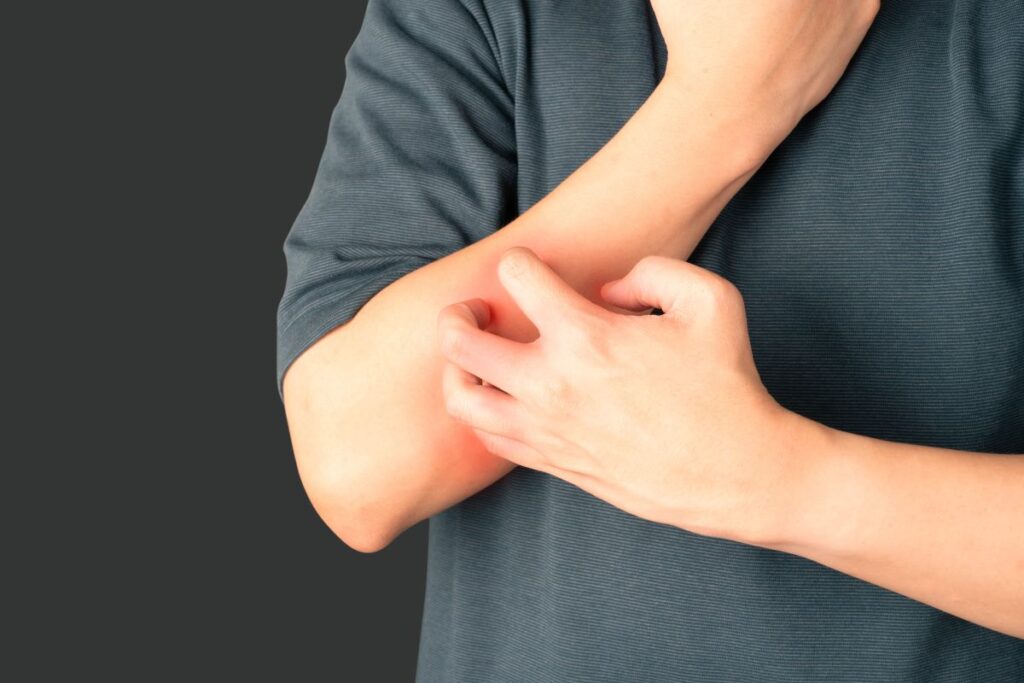
Flea bites cause severe itching (caused by the insect’s saliva), sometimes accompanied by slight local swelling.
➡️ Tip: clean the bitten area with soap and water, apply a soothing or antiseptic cream, and avoid scratching to limit complications.
Some sensitive individuals may experience a local allergic reaction.
Consult your doctor if necessary.
Difference between flea, mosquito and bedbug bites
| Insect | Appearance of the bite | Organisation of injections | Areas of the body most affected |
| Chip | Small red spots, sometimes with a central dot | In clusters or short rows | Legs, ankles, feet |
| Mosquito | Larger, round, and swollen button | Isolated | Arms, legs, face, exposed areas |
| Bed bugs | Red buttons in a row (1 to 5) | Online or in a regular group | Arms, back, neck, shoulders |
Bed bugs or bed bugs?
People often mistakenly refer to bed bugs as “fleas in bed”. This is a linguistic error: there is no species called “bed flea”.
These are two very different insects, even though they both bite and live in the human environment.
Confusing fleas with bed bugs can lead to incorrect treatment:
- for fleas, you need to treat the animal, floors and textiles,
- for bed bugs, you need to target bedding, furniture and corners near the bed.
Flea treatments
Flea treatment must always be comprehensive, as simply eliminating the insects visibles ne suffit pas : les œufs, larves et cocons restent présents dans l’environnement et peuvent relancer une infestation.

Treat your pet (essential)
If you have a dog or cat, the first thing to do is to use a suitable flea treatment:
- spot-on pipettes,
- flea collars,
- veterinary tablets.
Without treating your pet, the fleas will continue to feed and reproduce.
So remember to consultlter votre vétérinaire dès que possible.
Dealing with housing
Please note that during an infestation with fleas, 5% of the insects are found on the animal and 95% in the home.
You must therefore treat your home thoroughly:
- Vacuum carpets, skirting boards, sofas, baskets and cracks thoroughly.
- Wash textiles (cushions, blankets, baskets) at a high temperature.
- If necessary, use specific insecticides, fumigants or flea traps to reduce the adult population.
➡️ For more information: How to get rid of fleas effectively?

FAQ
Can fleas live on humans?
Do fleas jump on beds?
They do not live there permanently, but they can:
– bite during the night,
– fall off the body of an animal sleeping on the bed,
– hide in textiles (blankets, sheets).
Can an house with an infestation get rid of fleas on its own?
Without treatment:
– eggs continue to hatch,
– larvae develop in hidden corners,
– adults feed and reproduce.
– Action must be taken on both the animals (flea treatment) and the home (vacuuming, washing, targeted treatment).
Are flea bites dangerous?
– they cause intense itching,
– they can become infected if scratched,
– some people develop more severe allergic reactions.
How to recognise an infestation of fleas?
– clusters of bites on the legs, ankles or folds of skin,
– visible fleas in an animal’s coat,
– small black dots (faeces) in baskets, rugs or cushions,
– animal scratching intensely,
– sensation of rapid, repeated bites in the home.
