



Although things have been fairly quiet during this sweltering summer, the tiger mosquito hasn’t had its final say and remains active as early autumn sets in. According to official data, the insect is now firmly established in 83 mainland departments [1]. And it’s not about to stop any time soon! With current temperatures, its proliferation is likely to continue. Whilst the bites are a nuisance, they can, more importantly, transmit diseases such as dengue fever or chikungunya. Here is an overview of the current situation, along with some practical advice on how to protect yourself.
Key points to remember
➡️ The tiger mosquito is now established in 83 French departments and its range continues to expand.
➡️ Despite a scorching and very dry summer, it can remain active in September and October when temperatures are mild and rainfall encourages the formation of stagnant water.
➡️ In 2026, locally acquired cases of chikungunya and dengue continue to be reported in France, although they are fewer in number than in 2025.
➡️ The West Nile virus is also circulating widely this autumn. It is mainly transmitted by common mosquitoes of the genus Culex, and not by the tiger mosquito.
➡️ To protect yourself until the end of the season, continue to remove standing water and maintain green spaces.
Tiger mosquito: 83 departments infested in France
First spotted in mainland France in 2004, the tiger mosquito (Aedes albopictus) has continued to gain ground. As of 1 January 2026, it is now firmly established in 83 out of 96 departments [1].
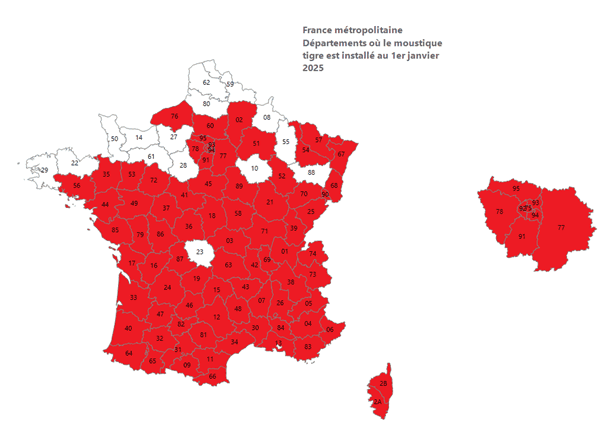
Source : Santé.gouv.fr
A ‘sustainable’ establishment means that populations have become established and are breeding locally. This expansion is expected to continue as a result of global warming. A study published in 2026 and reported by the IRD estimates that, by 2085, 72 per cent of mainland France could have conditions favourable to the establishment of the tiger mosquito [2].
How can this massive influx into France and Europe be explained?
Firstly, there is the globalisation of trade and transport, which facilitates the mosquito’s movement from one territory to another. But it is above all global warming that is to blame. When temperatures hover around 20 °C, the larvae can develop into adult mosquitoes in just one week. Higher temperatures also increase the fertility and life expectancy of these insects [2].
How can you report a sighting of a tiger mosquito?
Do you think you’ve spotted a tiger mosquito near your home? You can help with monitoring efforts by reporting it at:
If possible, take a clear photo of the mosquito or keep the specimen. The website also helps you to check that it is indeed a tiger mosquito before you submit your sighting.
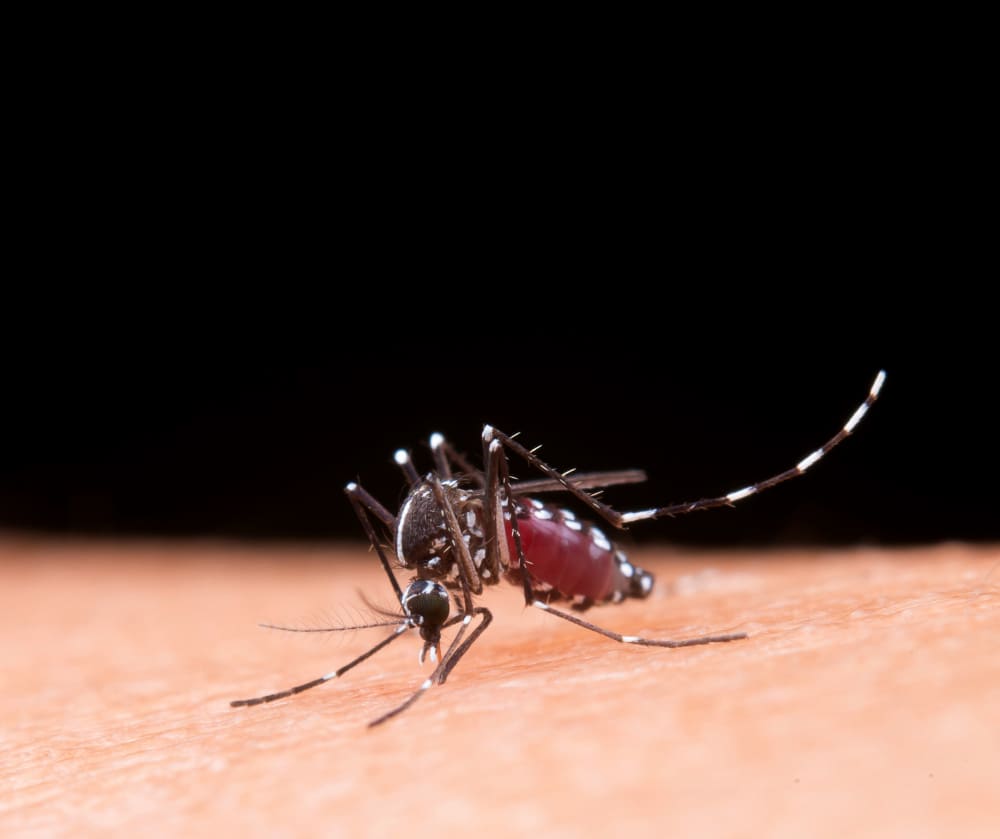
Key points: The tiger mosquito is small (around 0.5 cm), black with white stripes on its legs and a distinctive white line down the centre of its thorax. It bites during the day, particularly in the morning and late afternoon.

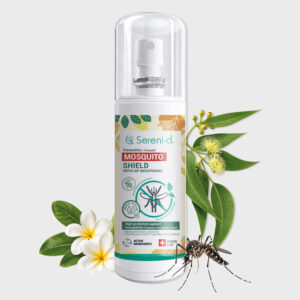
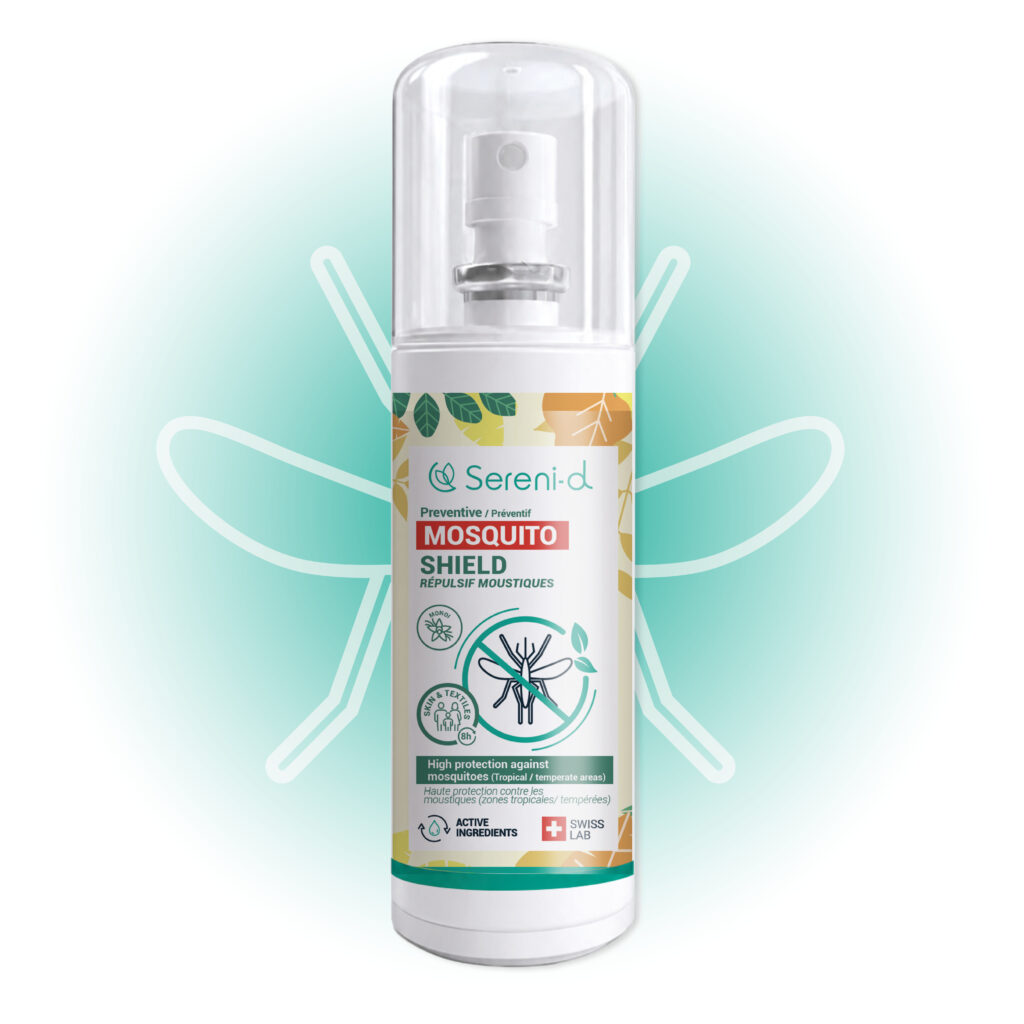
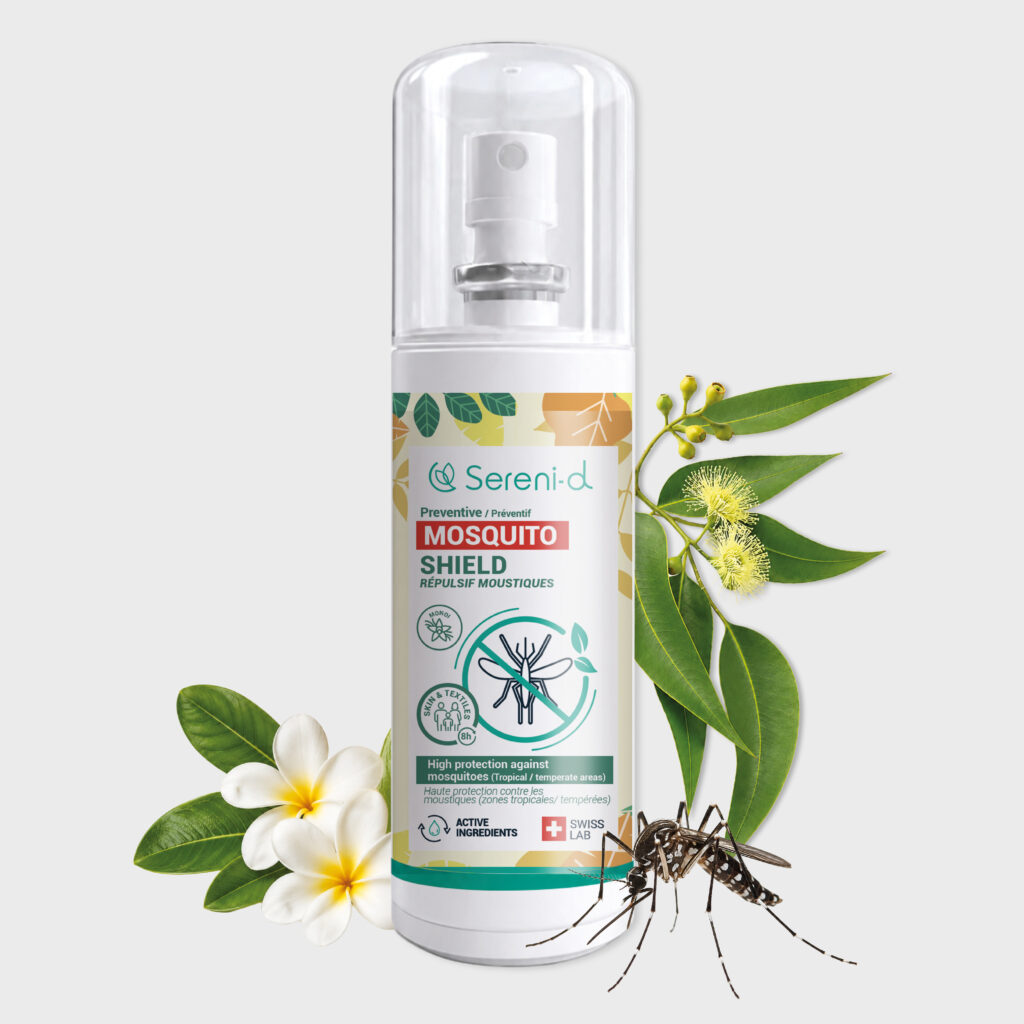
ANTI-MOSQUITO MONOÏ / Body & Fabric Repellent
- High-protection repellent spray against mosquitoes, tropical and temperate areas
- Immediate, long-lasting protection up to 8h — skin and clothing
- Suitable for the whole family from 6 months
- Over 250,000 satisfied Sereni-d® customers
CONCENTRATED FORMULA – MAXIMUM RESULT
In stock
Use biocides with care. Before use, read the label and the product information.
Fewer mosquitoes this summer: a false impression?
You may have had the impression that there were fewer mosquitoes this summer. This is not entirely surprising: France first experienced several heatwaves, and extreme temperatures can be detrimental to the tiger mosquito.
Another explanation is the record drought affecting the whole country. The summer of 2026 is the second driest on record since measurements began, with a 40 per cent rainfall deficit [3]. Less standing water = fewer places for them to lay their eggs.
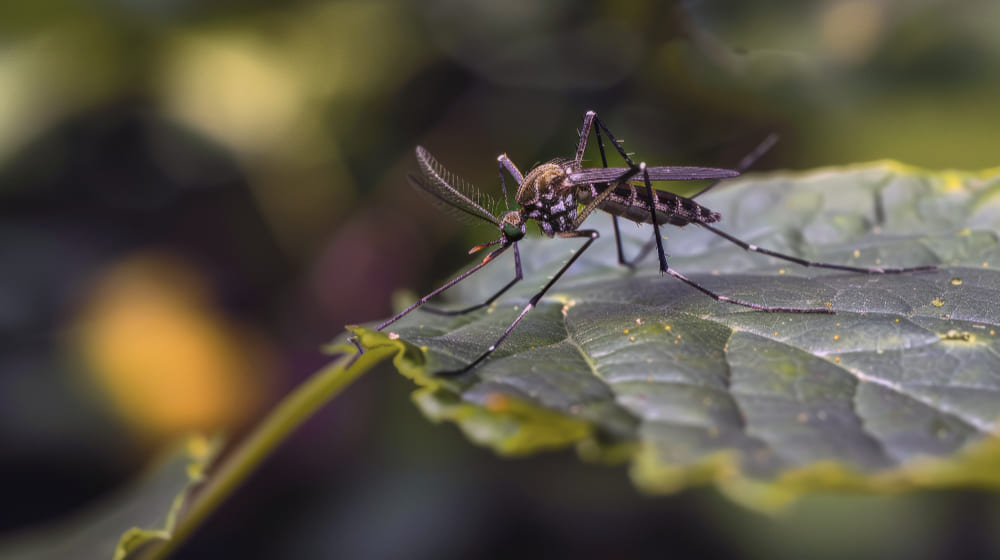
Why are tiger mosquitoes still around in September?
The situation changes with the arrival of autumn. Milder temperatures combined with a possible return of the rains can refill the small containers in which the mosquitoes breed. September therefore does not automatically mark the end of the season. The tiger mosquito can still bite in September and October, or even later if weather conditions remain favourable.
“It is highly resistant to the cold, and even to frost whilst in the egg stage. Once the temperature reaches around fifteen degrees, the eggs can hatch once they have been re-moistened or after the first rains, and the population can proliferate.”
Johanna Fite, Programme Officer for Vectors and Vector Control at ANSES – France 3 Régions
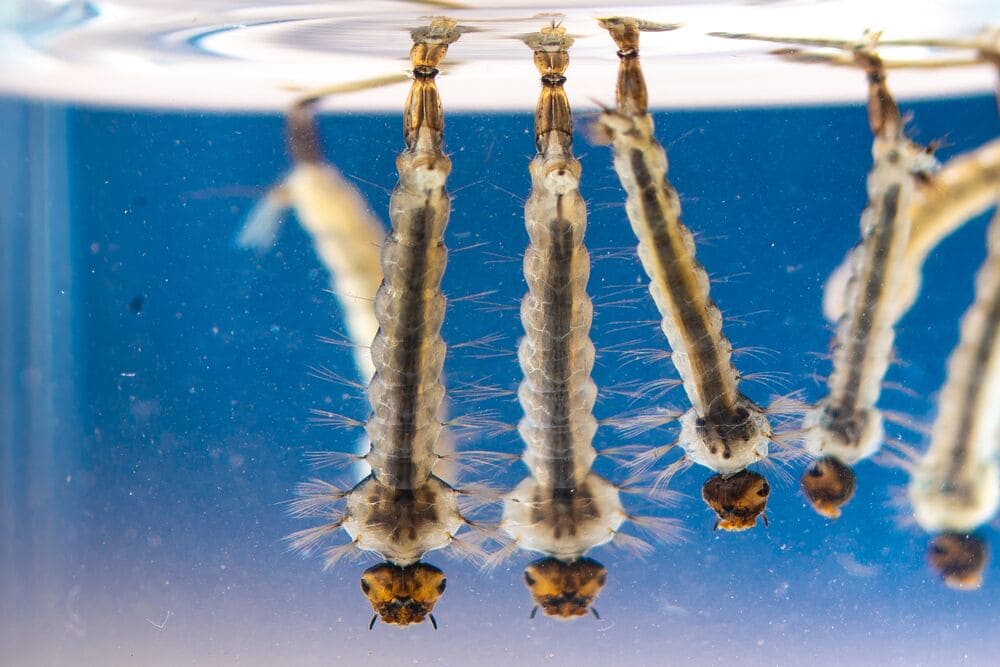
Eggs capable of surviving the winter
Nor does the arrival of the cold weather mean that the tiger mosquito disappears completely.
Its eggs can enter diapause, a form of dormancy that enables them to survive the winter.
A study examined the French population and found that the proportion of eggs entering diapause rises sharply in September. The first hatches observed after winter took place during the first half of March [4].
Chikungunya, dengue: indigenous cases are still being reported in France

Tiger mosquito bites can transmit several viral diseases, including chikungunya and dengue.
For your information, the symptoms are as follows:
- Chikungunya: sudden onset of fever, severe joint pain, headaches, muscle pain and, in some cases, a rash. The joint pain may persist for several weeks or even several months.
- Dengue: high fever, headaches, muscle and joint pain, nausea/vomiting and, in some cases, a rash.
As for transmission, the mechanism is fairly simple. A traveller infected abroad returns to France and is bitten by a tiger mosquito. The mosquito can then transmit the virus to another person by biting them.
A local case is defined as one where infection occurred in mainland France and is not linked to travel.
The year 2025 was particularly marked by chikungunya. 809 locally acquired cases were recorded, compared with 30 for dengue [5]. The widespread circulation of chikungunya was largely due to the epidemic affecting Réunion, which led to numerous imported cases in mainland France.
The situation was calmer in 2026, but local transmission continued:
| 2025 – Annual Review | 2026 – to 21 september | |
| Chikungunya: locally acquired cases | 809 | 90 |
| Chikungunya: transmission events | 79 | 13 |
| Dengue : locally acquired cases | 30 | 6 |
| Dengue : transmission events | 11 | 4 |
Sources : Santé publique France, bilan 2025 et bulletin du 23 septembre 2026 [6].
Chikungunya has mainly affected the south of France: the Tarn, the Lot, the Gironde and the Landes. Locally acquired cases have also been reported in Nogent-sur-Marne in the Val-de-Marne.
Dengue fever is circulating to a lesser extent. Six locally acquired cases spread across four outbreaks had been identified in the Tarn, Hérault, Dordogne and Bouches-du-Rhône as of 21 September [6].
What about the West Nile virus?
The West Nile virus (or Nile-West virus) is transmitted by common mosquitoes (genus Culex), which are present throughout France from May to November. There is no human-to-human transmission; mosquitoes become infected by biting birds carrying the virus.
In humans, the infection goes unnoticed in around 80 per cent of cases. Those who do experience symptoms present with mild flu-like symptoms, including fever and aches and pains. In fewer than 1 per cent of infections, serious neurological complications, such as meningitis or meningoencephalitis, may occur [7].
The circulation of the virus has accelerated significantly in recent weeks. As of 21 September 2026, there have been 117 human cases of West Nile virus infection in mainland France. Vaucluse (14 cases) and Var (11 cases) are the departments most affected [6].
This increase serves as a reminder that vigilance against ALL mosquitoes remains necessary in autumn, including after sunset.
How can you protect yourself from mosquitoes until the end of the season?
Here are a few simple steps to reduce the number of mosquitoes and the risk of being bitten.
The most important thing to do is: get rid of standing water.
- empty saucers, buckets, watering cans and other small containers regularly;
- store toys and objects that can hold rainwater away from the elements;
- cover water collection tanks with an airtight lid or a mosquito net;
- clean gutters and drains regularly;
- change the water in containers that cannot be emptied;
- scrub the sides of containers to remove any eggs that may be clinging to them.
Also remember to clear away and prune overgrown vegetation, which provides adult mosquitoes with cool, damp and shaded areas in which to rest.
Further reading: How to get rid of mosquitoes?

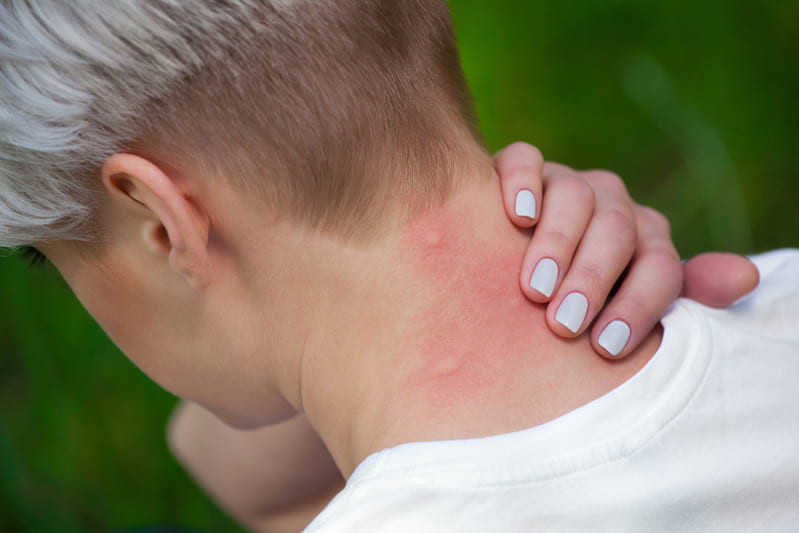
Protecting yourself from bites
To minimise mosquito bites, wear loose-fitting, long-sleeved clothing where possible, fit mosquito nets to windows and use a skin repellent suitable for each person’s age, such as Sereni-d® MONOÏ Mosquito Repellent.
Key point: If you experience a fever, joint or muscle pain, a headache or any other unusual symptoms following a mosquito bite or after returning from a trip, consult your doctor immediately.
ANTI-MOSQUITO MONOÏ / Body & Fabric Repellent
- High-protection repellent spray against mosquitoes, tropical and temperate areas
- Immediate, long-lasting protection up to 8h — skin and clothing
- Suitable for the whole family from 6 months
- Over 250,000 satisfied Sereni-d® customers
CONCENTRATED FORMULA – MAXIMUM RESULT
In stock
Use biocides with care. Before use, read the label and the product information.
FAQ
Will the tiger mosquito still be active in October?
Why are there fewer cases in 2026 than in 2025?
What diseases can the tiger mosquito transmit in France?
References
[1] Service Public – Présence du moustique tigre : informations pratiques et conseils. 2026.
[3] Météo-France, bilan de l’été 2026
[5] Santé Publique France Chikungunya, dengue et Zika en France hexagonale. Bilan 2025.
[7] Santé publique France. Virus West Nile – La maladie. Mise à jour le 23 septembre 2026.
