



Scabies is a contagious condition that causes skin problems, mainly itching. It is caused by a parasite called Sarcoptes scabiei.
What are the symptoms in adults and children? How does it differ from other skin conditions? Here’s how to recognise scabies and its different forms.
N.B.: This article is provided for information purposes only and is not a substitute for your doctor’s advice.
In summary
➡️The main symptom of scabies is intense itching, which is often worse at night, accompanied by spots, blisters or burrows.
➡️The hands, the spaces between the fingers, the wrists, the stomach, the buttocks and the genitals are among the areas most commonly affected.
➡️In infants, scabies can also affect the palms of the hands, the soles of the feet, the face and the scalp.
➡️The scabies burrows resemble small, fine, winding lines a few millimetres long that are difficult to spot with the naked eye.
➡️Scabies can be mistaken for eczema, an allergy, a fungal infection or insect bites. Only a doctor can confirm the diagnosis.
➡️Even after treatment, the itching may persist for 2 to 4 weeks.
Scabies: a highly contagious skin condition
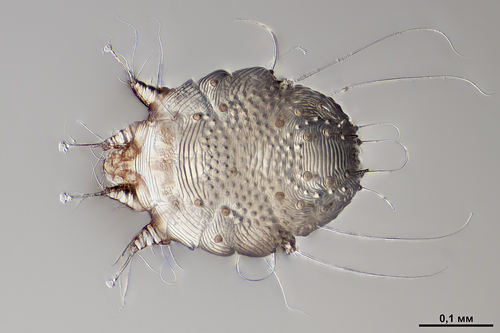
Human scabies is a parasitic skin condition caused by Sarcoptes scabiei var. hominis, a microscopic parasite belonging to the mite family. It is transmitted between people through prolonged skin-to-skin contact [1]. For this reason, living in communal settings facilitates the spread of scabies. Schools, nurseries and care homes are frequently affected.
In practice, the female parasite burrows small tunnels into the outer layer of the skin in order to lay her eggs there. Her presence and her faeces trigger a reaction in the body, causing itching and characteristic lesions.
👉 Known since ancient times, scabies has long been regarded as a disease of ‘unclean people’ and is still often seen as shameful. However, it is not linked to poor hygiene and can affect anyone, regardless of age or social background.
What are the early symptoms of scabies?
The main symptom of scabies is intense itching, which worsens at night. This itching can gradually spread to several areas of the body and affect several people within the same household [2] [3].
Skin lesions also appear: small red spots, blisters or ridges. Some are caused directly by the parasite, whilst others result from repeated scratching and may form scabs [2] [3].
👉 Upon initial infection, the symptoms of scabies do not appear immediately. According to the World Health Organisation, the incubation period is usually 4 to 6 weeks.
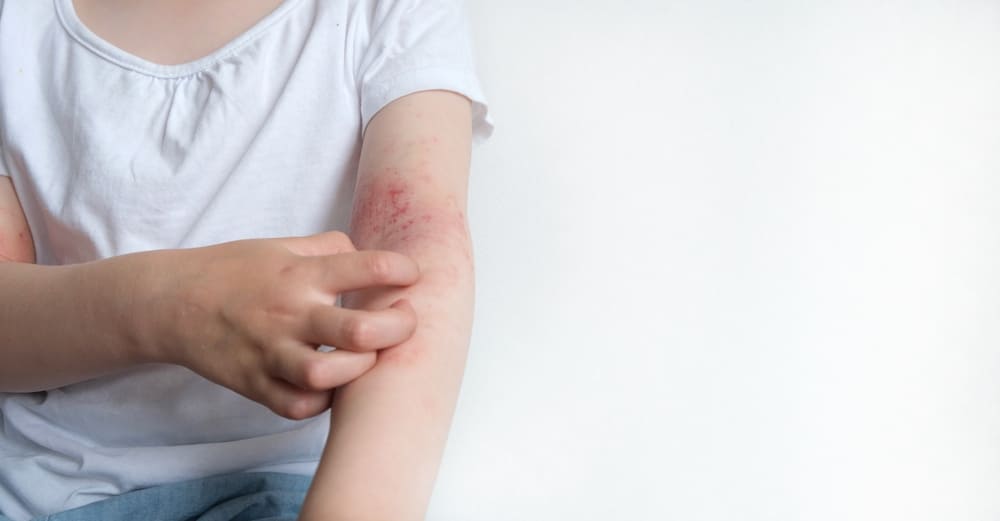
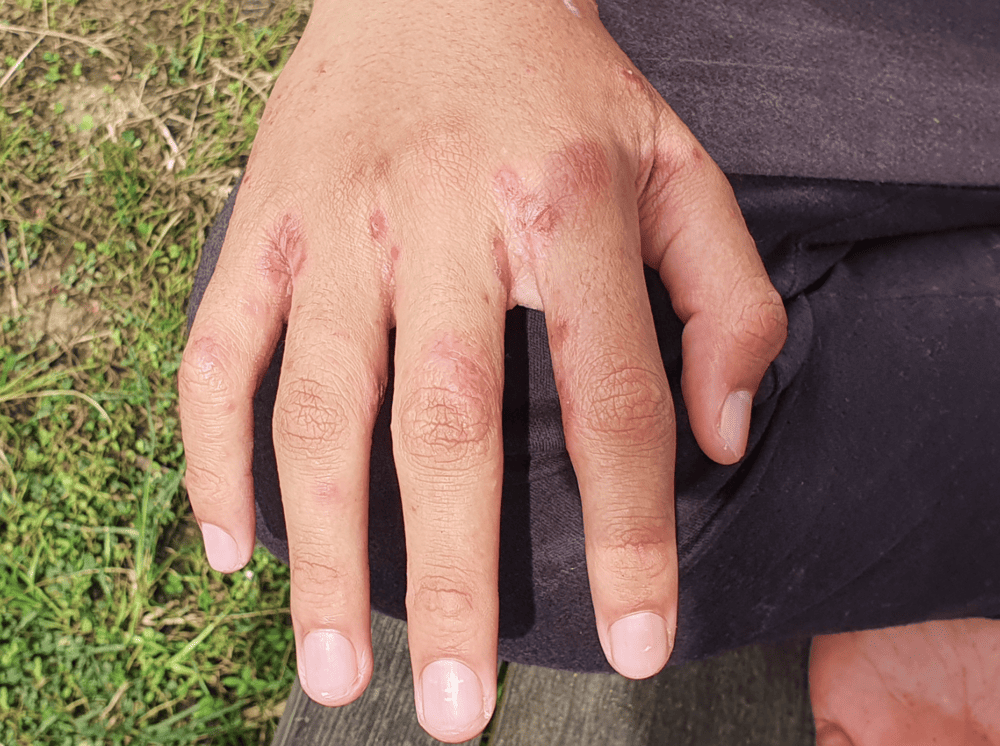
What do the early signs of scabies look like?
In the early stages of scabies, the first sign people often notice is an unusual itch that becomes more bothersome in the evening or at night.
Small spots may then appear between the fingers, on the wrists, elbows or around the waist. If a family member or someone living in the same household has the same symptoms, it is highly likely that they have scabies.
What are the different forms of scabies?
Scabies can take different forms depending on the number of parasites present and the extent of the lesions.
- Common scabies is the most common form. It mainly manifests as itching, which is often more intense at night, as well as spots, blisters and sometimes furrows on the skin.
- Profuse scabies causes far more numerous and widespread lesions across the body. It is much more contagious than common scabies.
- Hyperkeratotic scabies, also known as crusted scabies, is a rare but highly contagious form. In this condition, areas of skin become thickened and may form scabs containing a very large number of Sarcoptes mites.
The profuse and hyperkerattosique nécessitent une prise en charge médicale rigoureuse, notamment en raison de leur forte contagiosité.
Scabies in infants
In infants, lesions may affect, in particular, the palms of the hands, the soles of the feet and the face, unlike the usual presentation of common scabies in adults [2].
In babies, look out in particular for:
- itching and restlessness, particularly at night;
- pimples, blisters or other skin lesions;
- lesions on the palms of the hands and soles of the feet;
- possible involvement of the face and scalp, which are usually spared in adults;
- lesions or nodules in the armpits and sometimes on the genitals.
There is a risk of secondary infection if your child scratches too much. Do not use a scabies treatment intended for adults without medical advice.
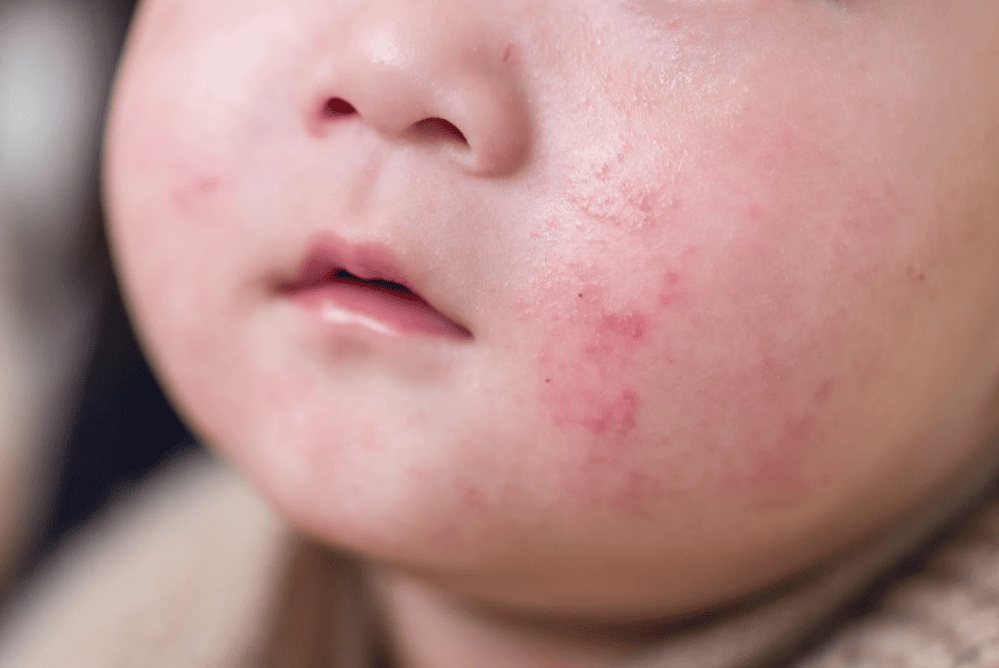
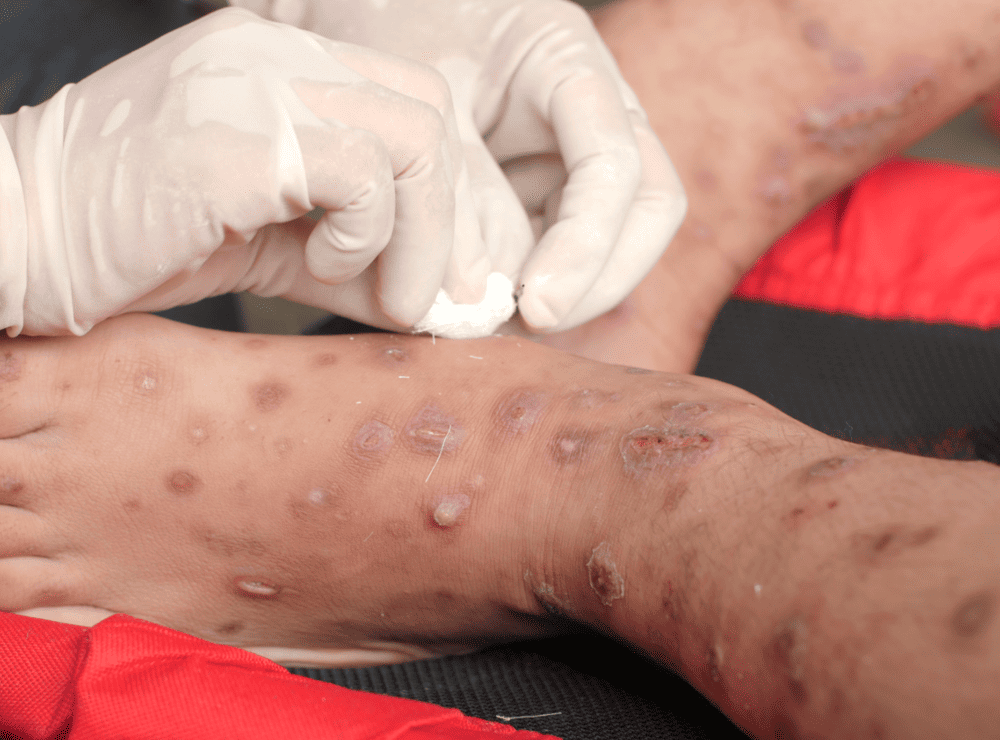
What do scabies spots look like?
Please note, there is no single type of spot characteristic of scabies. The appearance of the lesions varies depending on the individual, the area of the body affected and the extent of scratching.
On the skin, you may notice, in particular:
- small, slightly raised red papules;
- small blisters, sometimes filled with a clear fluid;
- red, irritated lesions;
- excoriations, i.e. small superficial sores caused by scratching;
- scabs, which may appear when the itching and scratching persist.
These scabies lesions are not always easy to identify and can be mistaken for eczema or irritation. A photo of scabies may help you spot certain similarities with your own lesions, but it is not sufficient on its own to confirm the diagnosisstic. En cas de doute, consultez un médecin.
How can you recognise the furrows caused by scabies?
The furrows caused by scabies are very characteristic of the condition.
👉 To the naked eye, a furrow looks like a small, fine, irregular and slightly winding line a few millimetres long. It may be whitish, greyish or similar in colour to the skin.
These are the tunnels dug by the female sarcoptic mite in the outer layer of the skin in order to lay her eggs there [2][4].
Where should you look for the lines?
Look first of all:
- between the fingers,
- on the front of the wrists,
- around the elbows,
- in the armpits,
- around the navel.
On which parts of the body does scabies appear?
Certain areas are affected more often than others, and the distribution can vary depending on age or the type of scabies.
| Body area | Key points |
| Hands and fingers | The spaces between the fingers, the sides of the fingers and the wrists are very distinctive areas. |
| Feet and ankles | The soles of the feet are particularly affected in infants and young children. |
| Stomach and waist | Lesions may appear around the navel and around the waist. |
| Buttocks | This is a fairly common site for scabies. |
| Back | The back is generally spared in adults with common scabies. |
| Genitals | In men, lesions may affect the penis and scrotum, amongst other areas. In women, the nipples and areolae may be affected. |
| Face and scalp | These areas are generally spared in adults, but may be affected in infants, young children or in certain specific forms of the condition. |
The location of the lesions varies depending on age and the type of scabies [2][3].
Can you get scabies on your face?
These areas are usually spared in adults, but may be affected in infants, young children or certain elderly or immunocompromised people.
Pimples on the face alone are therefore not enough to suggest the onset of scabies.
Scabies: how long do the symptoms last?
During a first infestation, the symptoms of scabies do not appear immediately. The incubation period is on average three weeks, but can vary from 1 to 6 weeks. In the event of re-infestation, it can be reduced to 1 to 3 days [2].
Once treatment has begun, the mites are eliminated, but the itching does not necessarily disappear straight away.
👉 Even after a course of treatment has been followed correctly, the itching may persist for 2 to 4 weeks, although this does not necessarily mean that the scabies is still active [2].
Consult your doctor again if your symptoms persist, get worse or if new lesions or ridges appear. They will be able to check whether this is a persistent skin reaction, a failure of treatment or a new infection.
Scabies or another skin condition: how can you tell the difference?
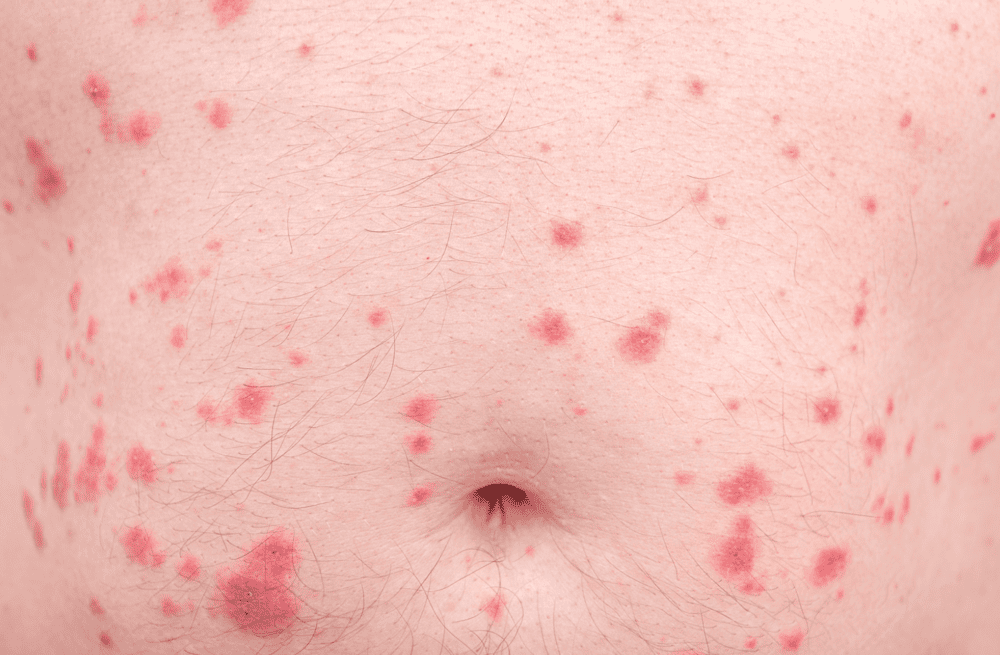
Having itchy spots does not necessarily mean you have scabies. Eczema, certain insect bites, allergies or fungal infections can cause similar symptoms. You need to take other clues into account, such as night-time itching, the location of the spots, the presence of burrows and any cases of scabies amongst those around you.
| Skin problem | How can you tell it apart from scabies? |
| Eczema | Red, dry, scaly or sometimes weeping patches. The characteristic furrows associated with scabies are absent. |
| Bed bug bites | Pimples that are often clustered together or lined up, mainly on the parts of the body that are exposed whilst sleeping. |
| Allergic reaction | Lesions of varying appearance that may develop rapidly following contact with or exposure to an allergen. |
| Fungal infection | Lesions that are often well-defined, sometimes rounded, with an appearance that varies depending on the type of fungal infection and the affected area. |
| Skin irritation | Redness and itching, often concentrated in the area that has been exposed to an irritant, friction or another triggering factor. |
How does a doctor diagnose scabies?
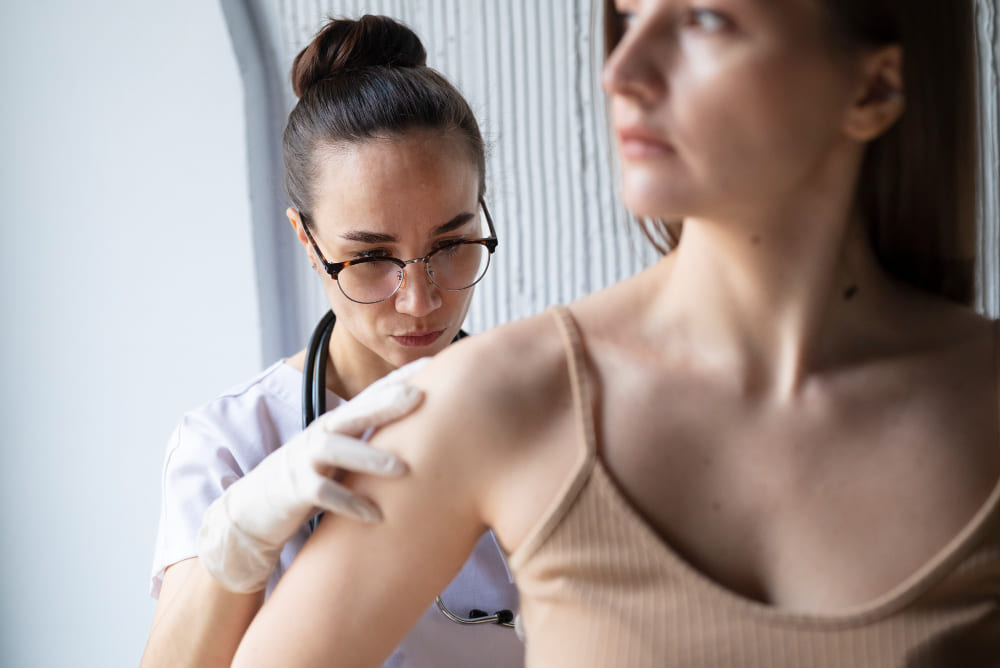
During an initial clinical examination, the doctor will observe the appearance and location of the lesions and look for characteristic signs such as furrows. They will also ask you about your itching, particularly at night, and whether anyone else in your household is affected.
If there is any doubt, they may use a dermatoscope, a device that allows the skin to be examined at high magnification, making it easier to spot the sarcoptic mite in a furrow. The international IACS criteria distinguish between several levels of diagnostic certainty. Direct visualisation of the sarcoptic mite or its waste products is particularly useful for establishing a confirmed diagnosis [4].
A skin scraping may also be carried out. The sample is then examined under a microscope to look for the mite, its eggs or its faeces.
In most cases, the symptoms and a skin examination are sufficient for the doctor to make a diagnosis.
👉 Once the diagnosis has been made, scabies is treated with topical and/or oral treatment. The itching may persist for between two and four weeks.
See also: Treatments for scabies
FAQ
Which condition might be mistaken for scabies?
What are the symptoms of scabies in a baby?
Is scabies visible to the naked eye?
Do scabies spots appear straight away?
Is it possible to have scabies without many spots?
Is the itching still there?
What are the different types of scabies?
References
